








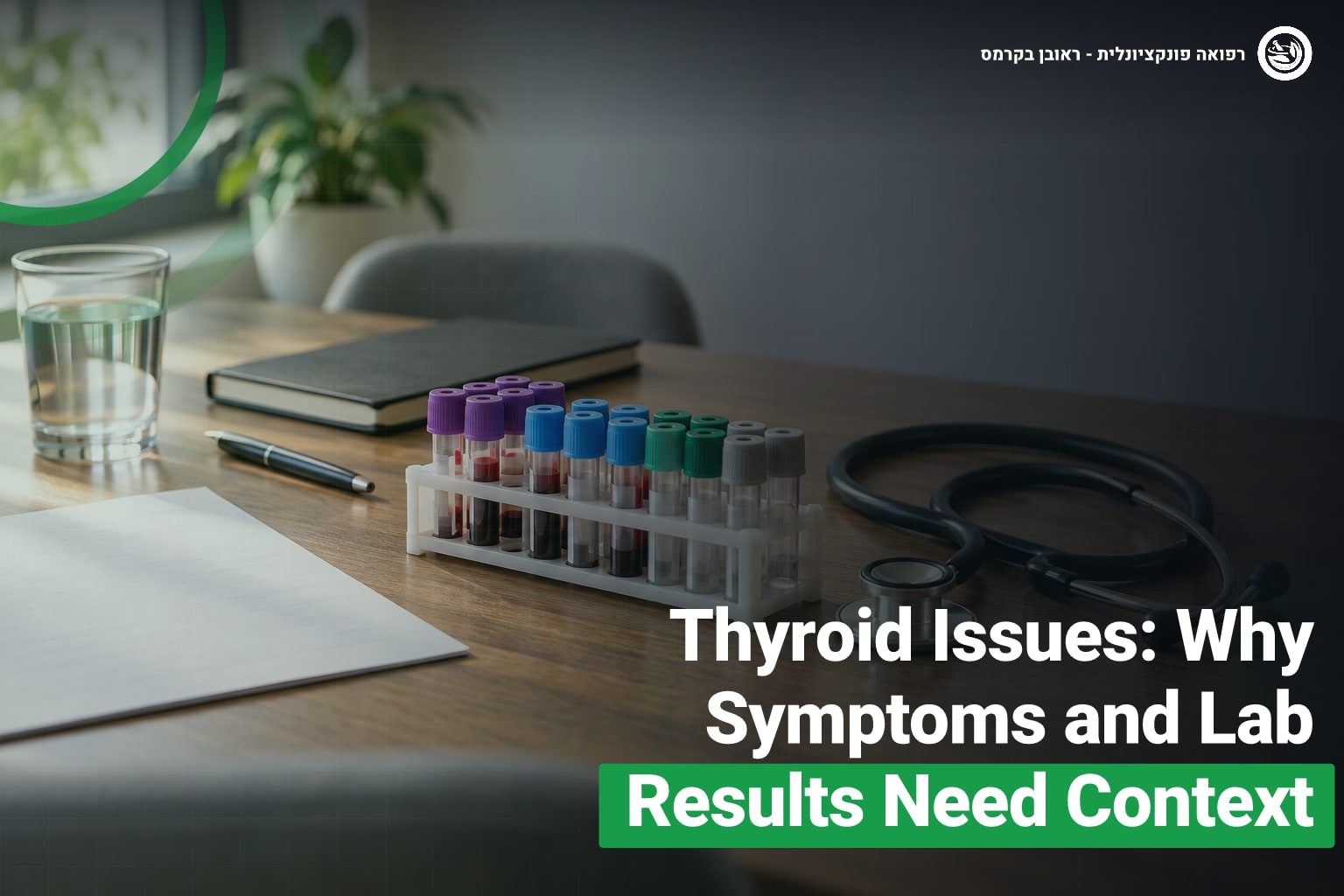
Thyroid issues often show up as a mix of tiredness, weight changes, feeling cold or wired, thinning hair, low mood and digestive shifts, and the same symptoms can come from stress, poor sleep, nutrient gaps or hormonal changes.
That is why a single lab value rarely tells the whole story.
A result inside the lab’s range does not always mean the thyroid is working well for that person, and an abnormal result does not explain why it happened.
The clearest picture comes from reading symptoms, a full set of tests, nutrition, stress, gut function and family history together.
At רפואה פונקציונלית – ראובן בקרמס, Dr.
Bek, a licensed chiropractor and naturopath in New York State with over 40 years in holistic and functional medicine, builds the review around the individual and not around one number.
If you have been told your tests are “fine” but you do not feel fine, a free 15-minute consultation is a simple first step.
What Are Common Thyroid Issues and Why Do Symptoms Overlap?
The thyroid is a small gland at the base of the neck that releases hormones influencing energy use, body temperature, heart rate, digestion and mood.
When it produces too little hormone, the condition is called hypothyroidism.
When it produces too much, it is called hyperthyroidism.
Nodules, goiter (an enlarged gland) and autoimmune conditions such as Hashimoto’s thyroiditis and Graves’ disease are other common patterns.
These conditions are more widespread than most people assume.
The American Thyroid Association estimates that about 20 million Americans have some form of thyroid disease, and that up to 60 percent of them are unaware of their condition.
The numbers differ from country to country, but the pattern of missed or late recognition is familiar to clinicians everywhere.
Part of the difficulty is overlap.
Fatigue, brain fog, constipation, hair loss, anxiety and weight changes can all point to the thyroid, and they can equally point to iron deficiency, low vitamin D or B12, blood sugar swings, perimenopause, chronic stress or poor sleep.
Someone may have a thyroid problem, a different problem, or both at once.
A useful way to read symptoms is by pattern and timeline.
When did they start, and what else changed around then, such as a pregnancy, a period of intense stress, an infection, a new medication or a major diet change?
Does anyone in the family have thyroid disease or another autoimmune condition?
Those details shape which tests are worth running and how to read them.
Why Can Normal Thyroid Blood Tests Still Leave Someone Feeling Unwell?
Most routine checks rely on one marker, thyroid-stimulating hormone (TSH), the signal the pituitary gland sends to tell the thyroid how much hormone to make.
A “reference range” is the span of values found in a healthy reference population at a given laboratory.
It is a statistical tool, and ranges vary slightly between labs.
Someone can sit inside it and still be symptomatic.
There are several reasons this happens.
TSH alone does not show how much active hormone reaches the tissues.
The thyroid mostly releases thyroxine (T4), which the body converts into the active form, triiodothyronine (T3), and that conversion depends on nutrients such as selenium, zinc and iron, as well as on stress load and liver and gut function.
A person can have an unremarkable TSH while conversion is not working smoothly.
Autoimmunity can also hide behind normal numbers.
In Hashimoto’s thyroiditis, the immune system produces antibodies against thyroid tissue, and these can be elevated for years before TSH moves.
Clinicians also use the term “subclinical hypothyroidism” for a mildly raised TSH with normal thyroid hormone levels.
Whether it needs attention depends on the person’s symptoms, age, antibodies and overall health, not on the number alone.
Testing conditions matter too.
TSH follows a daily rhythm and tends to be higher early in the morning and at night.
Biotin supplements, often taken for hair and nails, can interfere with some laboratory assays and distort results, so it is worth telling the clinician about every supplement before a draw.
Fasting, recent illness and certain medications can shift readings as well.
A veteran clinician in thyroid care might put it this way: a number on a lab report is a measurement, not a diagnosis, and it only becomes useful when it is placed next to the person who produced it.
That is the logic behind looking at more than one marker and more than one body system.
Which Tests Give a Fuller Picture of Thyroid Function?
No single panel suits everyone, and the choice of tests should follow the person’s history and symptoms.
The table below shows the markers most often discussed in a broader thyroid review and what each one adds.
Which tests are appropriate for you is a decision to make with a qualified practitioner and your treating physician.
| Test | What it shows | Context it adds |
|---|---|---|
| TSH | The pituitary signal that drives thyroid hormone production | A useful starting screen, but it does not show hormone activity in the tissues |
| Free T4 | The unbound storage hormone available to the body | Shows whether the gland is producing enough raw hormone |
| Free T3 | The active hormone that cells actually use | Helps assess how well T4 is being converted |
| TPO and thyroglobulin antibodies | Immune activity directed at thyroid tissue | Can point to an autoimmune pattern such as Hashimoto’s even when TSH looks typical |
| Ferritin, vitamin D, B12 | Iron stores and key vitamin status | Low levels can mimic or worsen thyroid-like symptoms such as fatigue and hair loss |
| Selenium, zinc, iodine status | Nutrients involved in making and converting thyroid hormone | Helps explain conversion and supports a personalized nutrition plan |
| Reverse T3 | An inactive form of T3 produced under some conditions | Its clinical value is debated, so it is interpreted cautiously and alongside other findings |
Beyond the thyroid panel, a wider view may include blood sugar and insulin markers, inflammation markers, sex hormones and cortisol, because these systems influence one another.
Functional Lab Testing and Nutritional Deficiency Testing are the services that cover this ground, and Functional Testing and Diagnostics brings the results together into one picture.
For patients with ongoing digestive complaints, Gut Microbiome Testing may also be discussed, since gut health and immune activity are closely connected.
What Does a Personalized Thyroid Review Involve?
The approach at רפואה פונקציונלית – ראובן בקרמס follows three steps.
It starts with a free 15-minute consultation to check whether the clinic is the right fit.
It continues with a comprehensive assessment of nutrition, hormones, vitamins and lifestyle.
It then moves to a personal treatment plan that may combine several methods under one roof.
The aim is to look for the root cause instead of silencing the symptom.
For one person, the relevant factors may be an autoimmune pattern, for another a nutrient gap, and for a third long-term stress affecting the adrenal and thyroid axes.
This is the idea of biochemical individuality: two people with the same TSH can have different underlying stories and need different plans.
Dr.
Bek’s approach draws on current nutritional and hormonal research, and the review also considers the connections between body systems, emotional patterns and family history.
Depending on what the assessment shows, the plan may include a Nutritional Consultation focused on functional nutrition, Hormone Balance support, Stress Management, and complementary methods such as acupuncture, applied kinesiology or EFT and NLP therapy for stress-related patterns.
These are meant to support the body’s own regulation.
They are not a replacement for medical care.
An important point for anyone already on thyroid medication: do not change or stop it without your prescribing physician.
A functional review works alongside conventional care.
Where it makes sense, the findings can be shared with your treating doctor so that decisions are made together and doses are adjusted only by those responsible for them.
For women in the years around menopause, thyroid symptoms and hormonal shifts can look almost identical, so the two are best evaluated together.
The Menopause Support and Thyroid Disorders pages explain how these topics are approached.
Frequently Asked Questions
Short answers to practical questions people ask before booking a thyroid-focused consultation.
Can ongoing stress affect thyroid function?
Stress hormones such as cortisol interact with the thyroid, and long periods of stress may influence how thyroid hormones are converted and used.
Stress is also a commonly reported trigger in people who later learn they have an autoimmune thyroid condition.
This does not mean stress alone causes thyroid disease, but it is one of the factors worth reviewing.
How often should thyroid levels be rechecked?
It depends on the situation.
After a medication change, physicians often recheck levels after several weeks, while stable patients may be tested once or twice a year.
Your treating doctor sets the schedule, and a broader panel can be added when symptoms and results do not match.
Should I stop thyroid medication to try a functional approach?
No.
Medication should only be adjusted by the physician who prescribed it.
A functional approach is designed to add information and support, such as nutrition, stress and lifestyle review, and not to replace prescribed treatment.
What should I bring to a first thyroid consultation?
Bring recent lab reports, including older ones for comparison, a list of medications and supplements with doses, and a short timeline of when your symptoms began.
Notes about thyroid or autoimmune conditions in your family are also valuable.
Thyroid Issues and Personalized Care at רפואה פונקציונלית – ראובן בקרמס
Lab numbers matter, but they are one chapter and not the whole book.
Symptoms, timing, nutrient status, stress, gut health, hormones and family history all shape how the thyroid behaves, and understanding that combination is what turns a confusing result into a clear next step.
The goal is not a guaranteed outcome, but a better understanding of why the body feels the way it does and a plan built around the person.
רפואה פונקציונלית – ראובן בקרמס brings more than 40 years of holistic and functional experience, a multidisciplinary approach under one roof, and a focus on root causes and biochemical individuality.
Care is available at the clinics in Ramat Beit Shemesh and Givat Ze’ev (Jerusalem), and through house visits across Israel.
If thyroid issues have left you with more questions than answers, book the free 15-minute consultation and start with your own story and your own lab results.